
Distal Acupuncture in Sydney: Why a Few Needles Can Create Whole-Body Change
If you've had acupuncture before, you might expect needles placed directly into a sore shoulder or an aching back. I work primarily in a distal style: often just one to three needles, placed far away from where you actually feel the problem. It looks minimal. The effects often aren't.
What Is Distal Acupuncture?
Distal acupuncture uses points on the hands, feet, and below the elbows or knees, rather than the painful area itself, to address pain, tension or dysfunction elsewhere in the body. Points are typically chosen on the opposite side, or along a related channel pathway, so the area of complaint is never directly needled.
This isn't a modern shortcut, though the specific method I practise, Evolve Style Acupuncture, is itself a more recently developed approach. It draws on classical Chinese medicine theory that predates the standardised curriculum most people associate with "TCM" (Traditional Chinese Medicine) today, synthesised into a distal, minimal-needle style of practice.
How It May Work
Needling at a distal point is thought to send a strong signal into the spinal cord and brain, which may trigger a broader regulatory response, affecting muscle tone, blood flow and pain perception well beyond the needle site. This is sometimes called a global change: rather than working on one muscle or joint, the aim is to shift how the nervous system as a whole regulates tension and pain signalling. One needle, in the right spot, may have effects across several systems at once, not just the single channel or local nerve it sits on. The central nervous system is treated as the primary regulator here, not the peripheral nerves alone.
Two ideas sit underneath this approach:
The aim is a whole-system shift, not symptom management. We're not chasing the pain around the body; we're aiming at the system that's producing it.
The body is understood as self-regulating. Our role isn't to force a result, but to support that regulatory mechanism into doing what it already knows how to do.
This is a proposed mechanism rather than settled fact, and individual responses vary.
I often picture a still lake. One needle is a single drop landing on the surface, small at the point of contact, but the ripple moves outward across the whole body of water. That's the global change distal work aims for: one to three needles, at the right points, felt well beyond where they actually are. Sometimes a needle needs fine-tuning: a small adjustment in angle or depth, the way you'd adjust exactly where that drop lands to change the shape of the ripple.
A note for needle-phobic clients: this style is perfect for you, as I'll never use more than three tiny needles, placed away from the sensitive area. We adjust the pace to suit you throughout.
What to Expect in a Session
A cosy, private room. Soft music, low lighting, and a comfortable treatment table.
Clothes stay on. Loose clothing you can push up from the elbows and knees; most work happens below the elbows or knees, and on the hands.
You lie on your back, propped comfortably with pillows.
Palpation first. I feel through the jaw, neck, shoulders, back and spine, glutes, legs and abdomen for tightness or restriction, checking in as I go, so we find areas of tension together.
One to three needles go in at distal points, not into the tight area itself.
I check the change. Reassessing the same spots, a noticeable easing in your areas of physical tension is often taken as a sign the nervous system has responded.
Time to rest and rebalance, while your own endorphin response keeps working.
Every person responds differently, and results can vary session to session.
Classical Acupuncture vs 1970s-Style TCM
Classical, lineage-based acupuncture theory, including channel and image-based approaches to point selection, has been developed and refined over centuries, generally passed down through direct teacher-to-student mentorship rather than a single standardised syllabus. Standardised TCM, by contrast, was formalised in China from the 1950s-70s into the unified curriculum most colleges now teach, a broader system combining local and distal points within a syndrome-differentiation framework.
I practise the Evolve Acupuncture Method, which is a more recently developed synthesis: it draws on that older classical theory but is a modern approach in its own right, not itself a centuries-old family lineage. I layer it with standardised TCM diagnostics in my own practice.
If you'd prefer more needles and a local style, directly into the affected area, there are plenty of practitioners who work that way. Just make sure whoever you see is registered with AHPRA and belongs to a recognised association such as AACMA or ATMS.
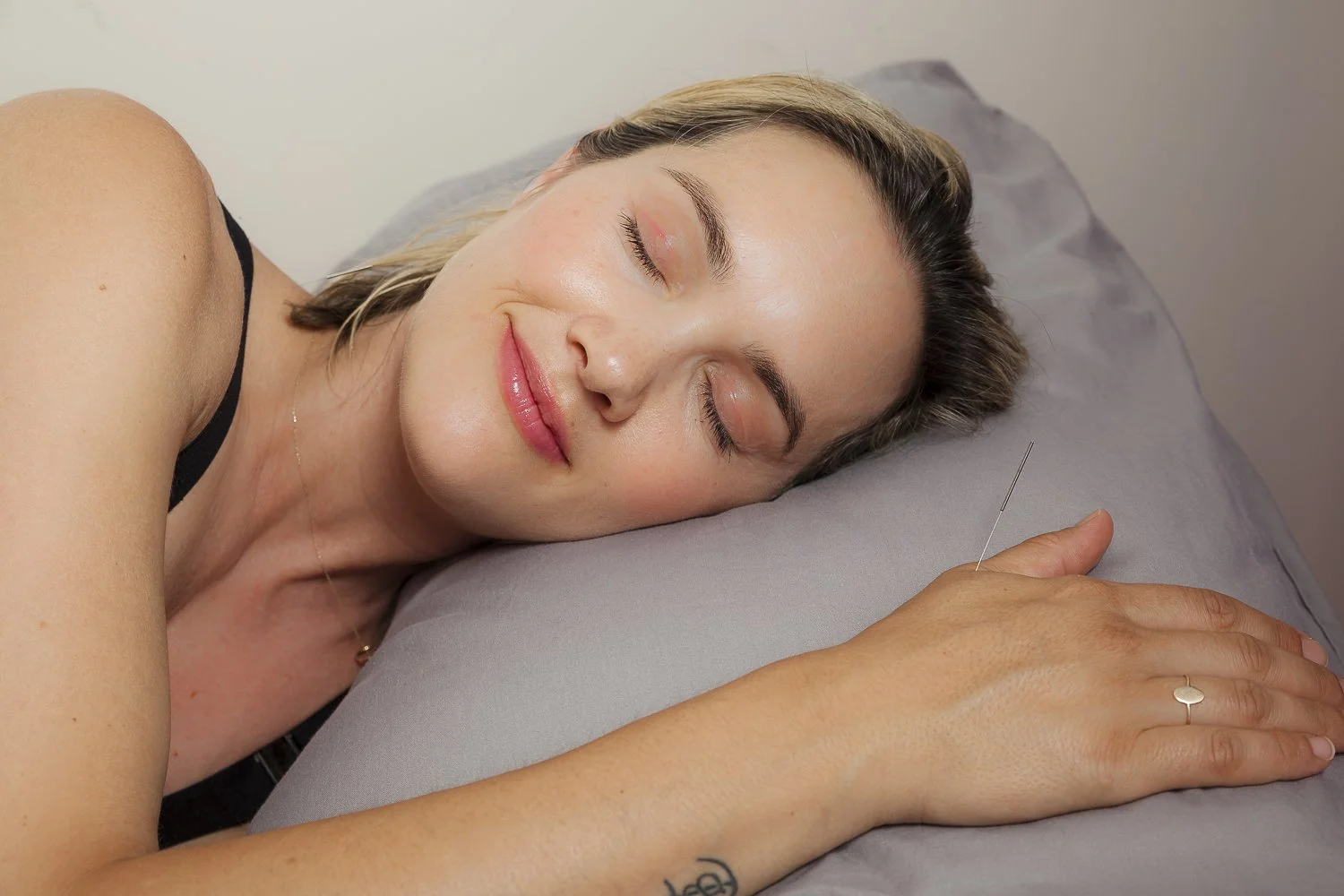
Distal acupuncture session in progress, Leichhardt acupuncture clinic.
Frequently Asked Questions
What is Evolve Style Acupuncture? It's the specific method I practise: a distal, minimal-needle approach that draws on classical acupuncture theory, built around one to three needles placed away from the affected area to prompt a whole-system response through the central nervous system.
Will you put needles in my sore spot? No. That's the point of this style. We work at a distance and let the effect travel: like a single drop on a still lake, not a hand stirring the water directly.
Isn't more needles better? Not in this style. One to three well-chosen points is usually enough to start the ripple. Less is more: the skill is in where the needle goes, not how many go in.
Is distal acupuncture painful? Most clients find it very comfortable: often just one to three needles, in the hands, feet or below the elbows or knees, rather than a tender area.
What should I wear to my appointment? Loose clothing you can push up from the elbows and knees down; no need to undress.
Is this suitable if I'm scared of needles? Often, yes. One to three needles, placed away from the sensitive area, and we adjust the pace to suit you.
How is this different from standard TCM acupuncture? Distal acupuncture, including Evolve Style Acupuncture, uses specific points away from the complaint. Standardised TCM generally combines local and distal points within a broader diagnostic framework.
In Summary
Distal acupuncture is less-is-more, by design. One to three needles, placed well away from where it hurts, is often enough to start the ripple; the ripple does the rest. By palpating carefully and reassessing after needling, we can usually feel that shift happen in real time.
Curious to see if it suits you? Come and try the Evolve Acupuncture Method for yourself. I treat clients from my Inner West Sydney clinic rooms in both Leichhardt and Marrickville.
This article is general information only and does not replace individualised clinical advice. Please consult your acupuncturist or medical practitioner about your specific circumstances.